Issue
- You have a suspicious file, suspicious website, potential false positive, or potential miscategorization by Parental Control or Web control that you would like to submit to ESET for analysis
- Submit samples using your ESET application
- Submit a suspicious file / potential false positive file or application for analysis via email
- Submit a suspicious website / potential false positive website / potential website miscategorization
Solution
Submit samples using your ESET application
If you prefer not to send an email, use the sample submission form in your ESET application.
-
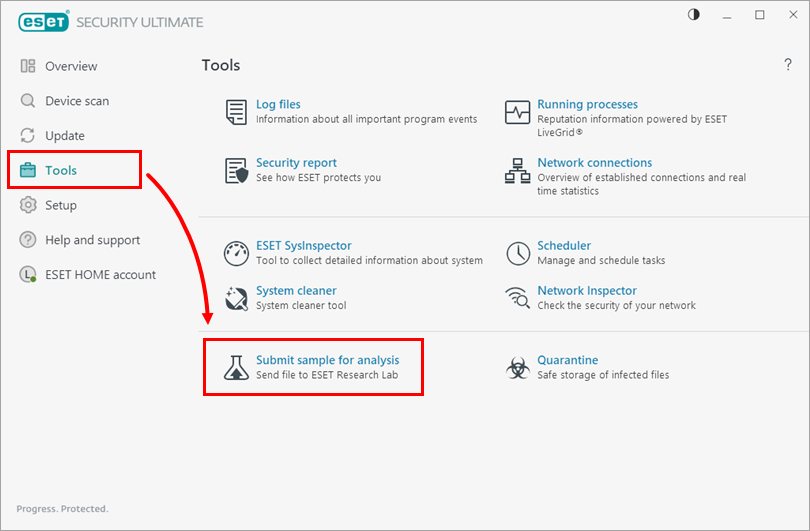
Open the main program window of your ESET Windows application.
-
Click Tools → Submit sample for analysis.
-
There are four actions you can take:
Submit a suspicious file
-
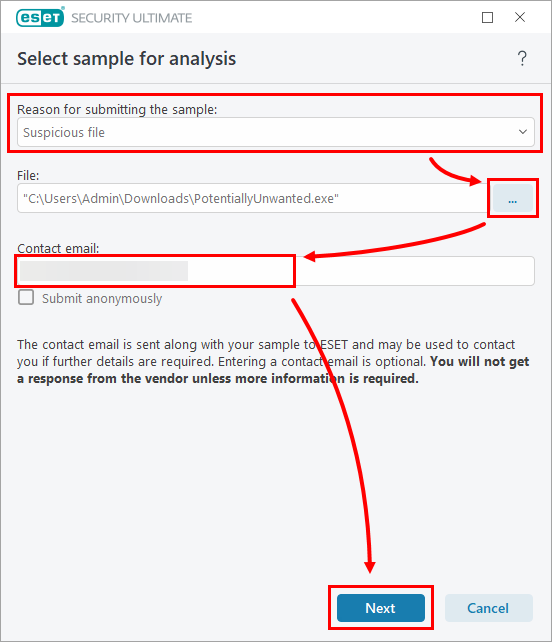
In the window Select sample for analysis, fill in these fields and click Next.
- Select Suspicious file in the Reason for submitting the sample drop down menu.
- Click the button with three dots and navigate to the file you wish to submit.
- Optionally, fill in your email address in the Contact e-mail field. Keep in mind you will not receive a response unless further information is required.
-
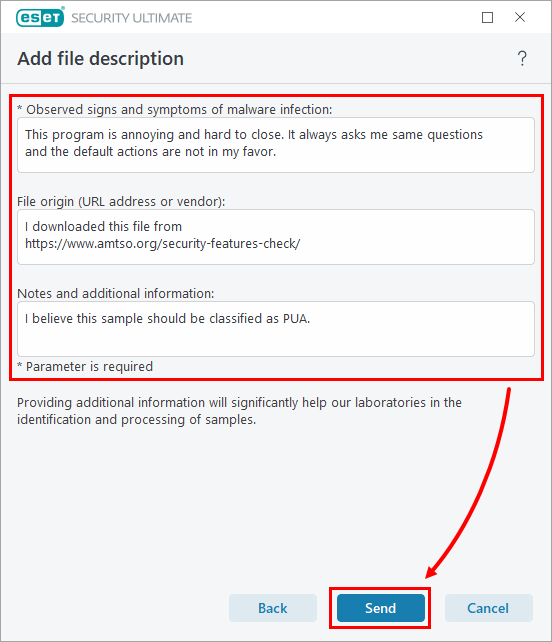
In the window Add file description, fill in these fields and click Send.
- The observed signs and symptoms you have seen on your computer that you believe are a result of this file. Describe how the infection manifested: common signs include (but are not limited to) excessive CPU usage, excessive network usage, firewall reporting unexpected network traffic, unexpected browser setting changes, ads being displayed, files copied automatically via network shares/removable drives, documents getting encrypted, programs asking for a ransom, and applications being hard to close.
- The origin of the file: where did you download it from, what website, or other means.
- Any additional notes and explanations you can offer to help ESET Research Lab analyze the file.
Submit a false positive file
-
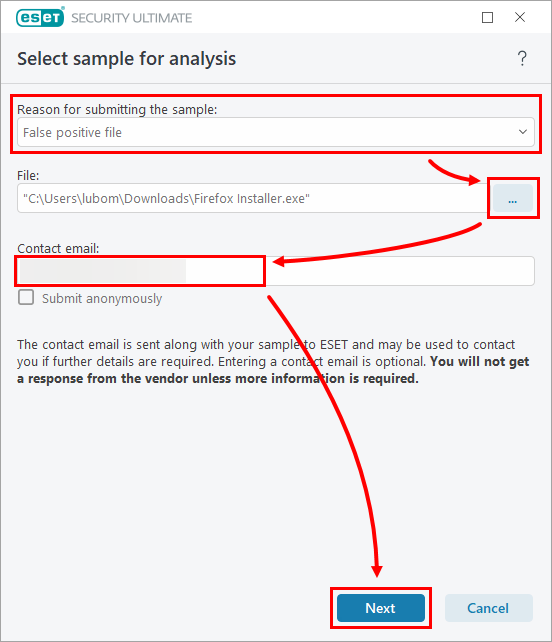
In the window Select sample for analysis, fill in these fields and click Next.
- Select False positive file in the Reason for submitting the sample drop down menu.
- Click the button with three dots and navigate to the file you wish to submit.
- Optionally, fill in your email address in the Contact e-mail field. Keep in mind you will not receive a response unless further information is required.
-
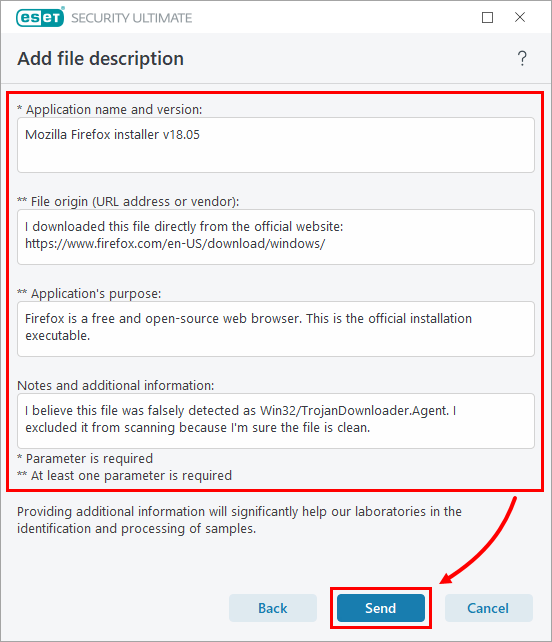
In the window Add file description, fill in these fields and click Send.
- The file name and version (if available).
- The origin of the file: where did you download it from, what website, or other means.
- The purpose of the file: what does it do and why you believe it is a false positive.
- Any additional notes and explanations you can offer to help ESET Research Lab analyze the file.
Submit a suspicious site
-
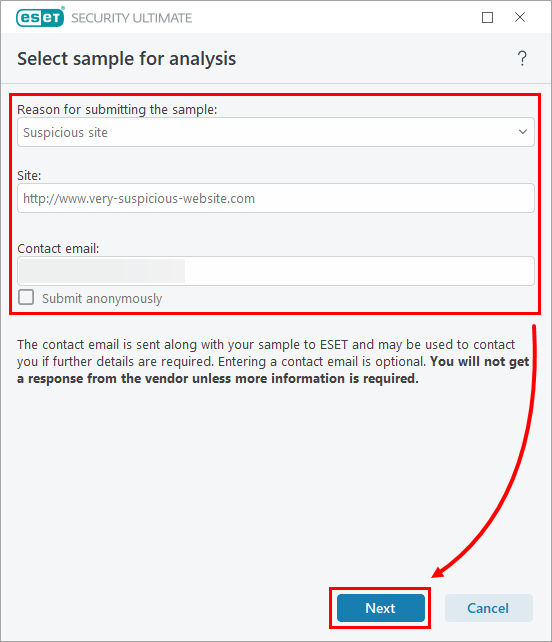
In the window Select sample for analysis, fill in these fields and click Next.
- Select Suspicious site in the Reason for submitting the sample drop down menu.
- Input the website URL.
- Optionally, fill in your email address in the Contact e-mail field. Keep in mind you will not receive a response unless further information is required.
-
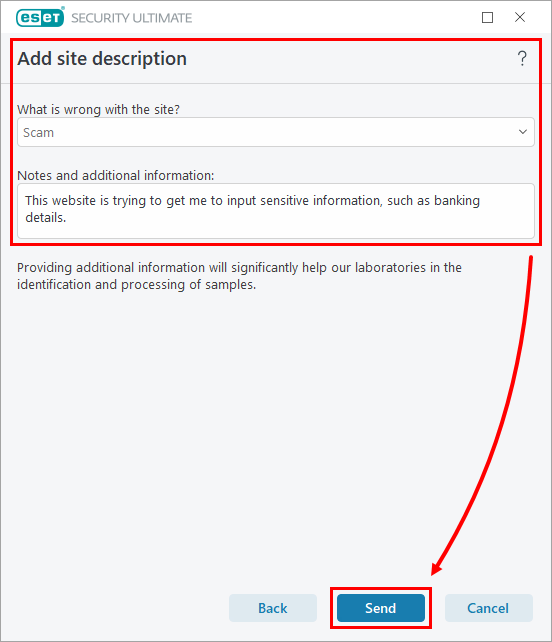
In the window Add site description, fill in these fields and click Send.
- In the drop-down menu select the behavior you have seen on the site.
- Any additional notes and explanations you can offer to help ESET Research Lab analyze the site.
Submit a false positive site
-
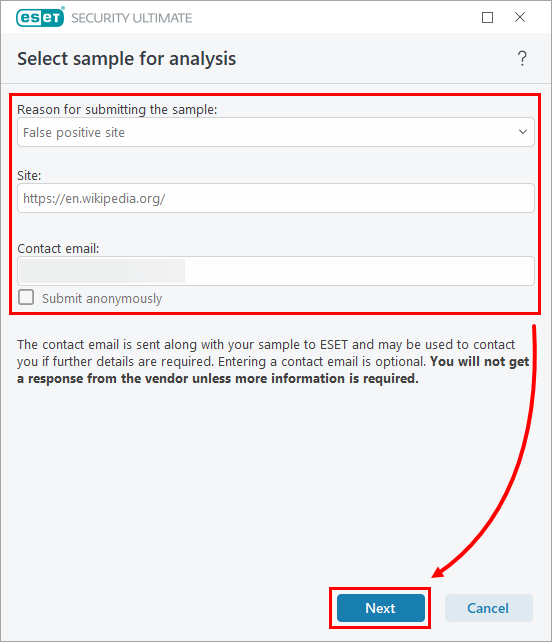
In the window Select sample for analysis, fill in these fields and click Next.
- Select False positive site in the Reason for submitting the sample drop down menu.
- Input the website URL.
- Optionally, fill in your email address in the Contact e-mail field. Keep in mind you will not receive a response unless further information is required.
-
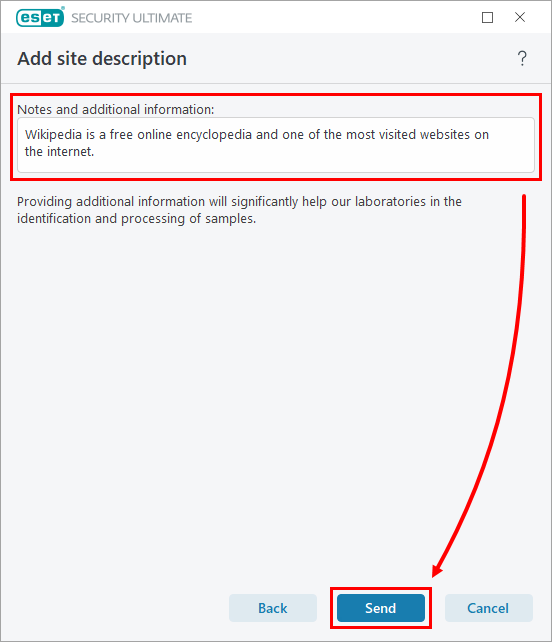
In the window Add site description fill in why you believe this is a false positive and any notes and explanations you can offer to help ESET Research Lab analyze the site.
-
Submit a suspicious file / potential false positive file or application for analysis via email
Submit a suspicious or potential false positive file
-
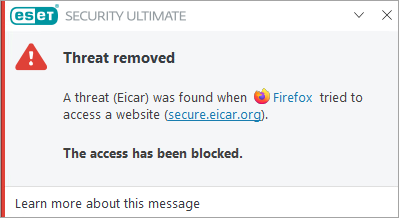
Take screenshots of the threat detection notification you receive from your ESET application or any error messages or suspicious behavior that your computer is exhibiting.
-
Compress the files into a
.zipor.rararchive and password-protect it with the password "infected". -
Create and send an email with the following information:
-
In the Subject line: Indicate if the attached file contains a suspected infection or a false positive (for example, use the subject
Suspected infectionor the subjectFalse positive). -
In the body of the email: Make a note of the password you set in step 2 and attach the
.zipor.rararchive as well as any screenshots. Include any background information where you found the sample and, if applicable, the ESET Technical Support case number. -
In case the computer is already infected, include logs collected by ESET Log Collector.
-
Send the email to: samples@eset.com.
-
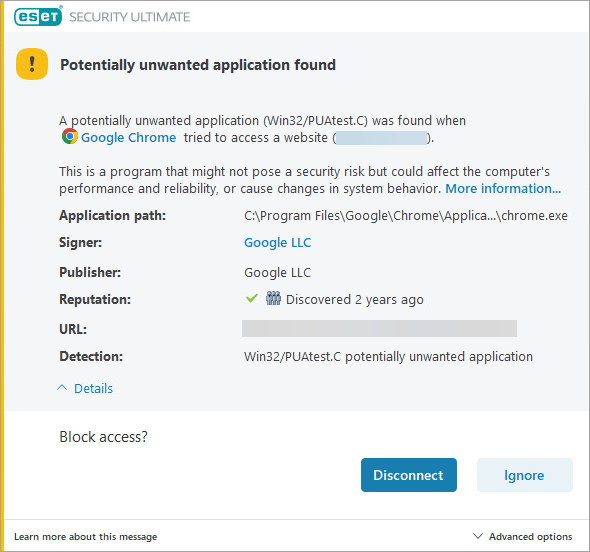
You are a software vendor, and ESET detects your app as a Potentially unwanted application (PUA)
Some "Threat found" or "Threat removed" detections are classified as PUA. If you think that an app was incorrectly detected as PUA, follow the steps below:
-
Take screenshots of the threat detection notification you receive from your ESET application.
-
Compress your application files into a
.zipor.rararchive and password-protect it with the password "infected". -
Create and send an email with the following information:
-
In the Subject line: Indicate that the attached file contains a false positive (for example, use the subject "PUA - False positive").
-
In the body of the email: Make a note of the password you set in step 2 and attach the .zip or .rar archive as well as any screenshots. Include any background information where the sample is available and, if applicable, the ESET Technical Support case number.
- Send the email to: samples@eset.com.
-
The issue is not resolved within three days, and the matter is urgent
Send a follow-up email message with the following information:
- The subject line of the email that you sent to samples@eset.com.
- Date and time of email.
- The email address you sent it From.
Submit a suspicious website / potential false-positive website / potential website miscategorization
Follow the appropriate instructions below, depending on the type of issue you want to submit:
Report a suspicious website or false-positive website via email
Create and send an email with the following information:
- In the Subject line: If you are reporting a blocked website that may contain potentially dangerous content, include
Domain whitelistfollowed by the blocked domain (such as www.blockeddomain.com). - In the body of the email: Include the URLs being blocked or that you found suspicious.
- Why do you think it is a false positive report. Provide as much information as possible about the source of the software, including the name of the developer, the name, and the application version.
- If you are reporting a blocked website, provide the complete URL that is blocked. Enclosing a screenshot of the notification about the blockage is recommended.
- Send the email to: samples@eset.com.
If the issue is not resolved within three days and the matter is urgent, send a follow-up email message with the following information:
- The subject line of the email that you sent to samples@eset.com.
- Date and time of email.
- The email address you sent it From.
Submit spam or spam false positives
- Email incorrectly marked as spam: If you received an email message classified as spam by your ESET application, and you do not recognize it as spam, send an email to nospam@eset.com with the original message as an attachment in
.emlor.msgformat. - Undetected spam: If you received an email message that you classify as spam, but your ESET application did not classify it as spam, send an email to spam@eset.com with the original message as an attachment in
.emlor.msgformat.
If you are using ESET Cloud Office Security, use the dedicated email addresses nospam_ecos@eset.com and spam_ecos@eset.com to report false positive (FP) / false negative (FN) detections for spam. For detailed instructions, see ESET Cloud Office Security Online Help.
You can also submit a sample from inside your ESET application.
Submit a miscategorization of a website by the Parental control or Web control module
Report a miscategorized URL or website here.
If you have already reported it and the website is still miscategorized, contact your local ESET partner for technical support.
- Click here to learn more about ESET Parental control in ESET Windows home applications.
- Click here to learn more about Web control in ESET Windows endpoint applications.
Submit a fraudulent page (phishing)
If you believe you have deliberately and deceitfully discovered a similar page to another, complete this form to notify us.


