Issue
- Prerequisites
- Resolve cloning questions
- Mark a computer as a Master for Cloning
- Define a computer's identity-handling behavior for clone processing
- Handling computer clones
Details
Click to expand
ESET PROTECT and ESET PROTECT On-Prem include mechanisms to handle VDI (Virtual Desktop Infrastructure) environments, machine cloning, and non‑persistent desktops, where multiple computers may originate from the same base image. Whenever a computer is cloned, the server pauses replication and generates a cloning question to determine how to handle the clone's identity.
When resolving a cloning question, you can decide to reuse an existing computer identity (recommended for VDI and re-imaging scenarios, where cloned instances should reconnect to an existing logical computer rather than creating duplicates) or create a new identity (recommended for deployments where each clone must become a separate computer).
To avoid receiving a question every time a computer is cloned, you can define the clone identity-handling behavior for a computer through the Master for Cloning setting. When a computer is marked as a master, the server automatically applies the selected identity‑handling rule to all future clones generated from that computer.
For more information, see VDI, cloning and hardware detection (ESET PROTECT) or VDI, cloning and hardware detection (ESET PROTECT On-Prem), or supported VDI environments and their supported features.
Solution
Prerequisites
At least one client computer with ESET Management Agent installed and connected to ESET PROTECT or ESET PROTECT On-Prem
Resolve cloning questions
After you clone and power on a computer in your virtualization management platform, by default, you must resolve a cloning question to determine how the clone's identity should be handled in ESET PROTECT or ESET PROTECT On-Prem. For more information, see Resolving cloning questions (ESET PROTECT) or Resolving cloning questions (ESET PROTECT On-Prem).
-
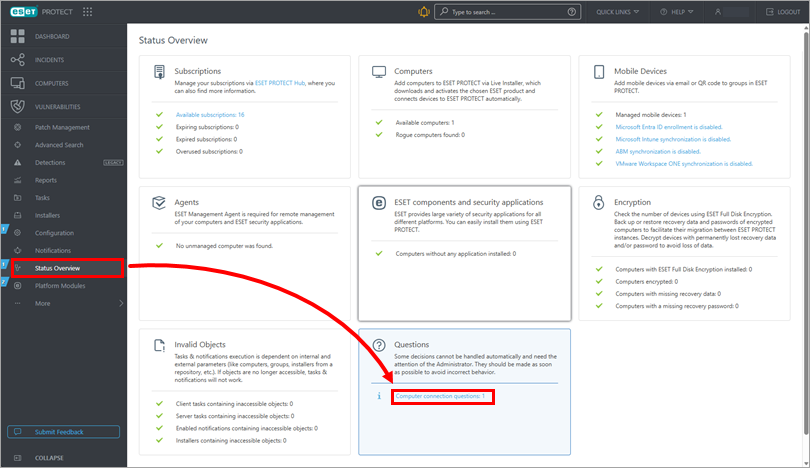
Click Status Overview and click Computer connection questions under Questions.
-
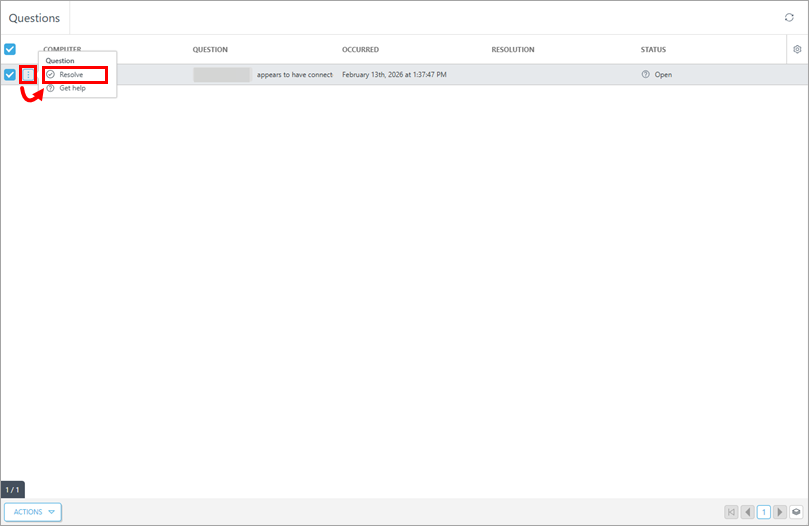
Click the three dots next to the target question and select Resolve.
-
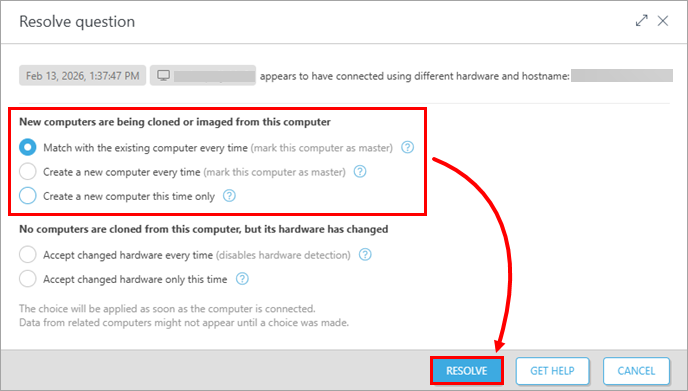
Choose how the clone's identity should be handled: select an option and click Resolve.
-
Match with the existing computer every time (mark this computer as master): the clone will reuse the source computer's identity and not become a new separate computer (recommended for VDI and re-imaging scenarios). The source computer will be marked as Master for Cloning and its future clones will automatically reuse the its identity; no future cloning questions will be generated.
-
Create a new computer every time (mark this computer as master): the clone will become a separate computer with a new identity (not recommended for VDI environments). The source computer will be marked as Master for Cloning and its future clones will automatically become separate computers; no future cloning questions will be generated.
-
Create a new computer this time only: the clone will become a separate computer with a new identity (not recommended for VDI environments); the future clones of the source computer will still trigger a cloning question.
-
-
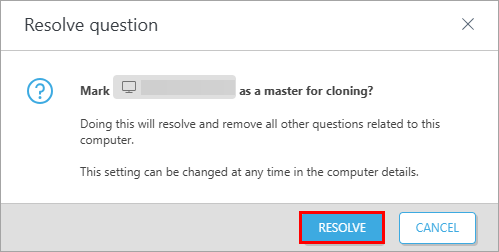
If you selected an option including the Master for Cloning setting, read the information in the related dialog box and click Resolve.
Mark a computer as a Master for Cloning
The Master for Cloning setting marks a computer as the master image for creating clones and defines how the identity of the clones should be handled. This automates the cloning process, as it stops the cloning questions from being generated. For more information, see Master for Cloning (ESET PROTECT) or Master for Cloning (ESET PROTECT On-Prem).
-
Access the Master for Cloning setting.
ESET PROTECT
-
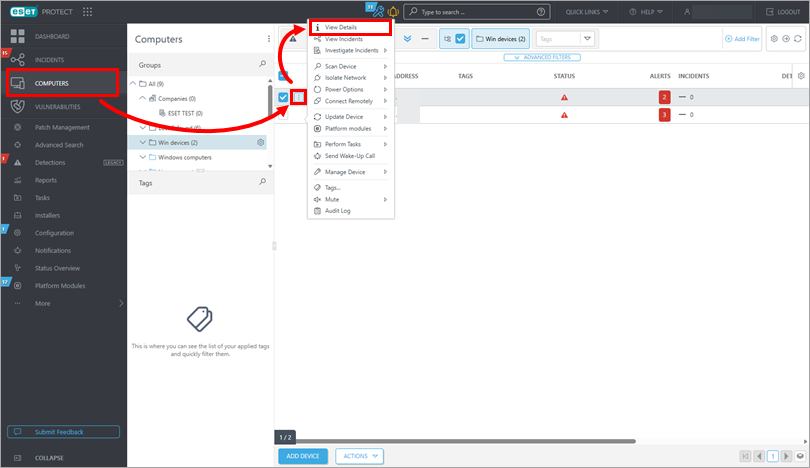
Click Computers, then click the three dots next to the target computer and select View Details.
-
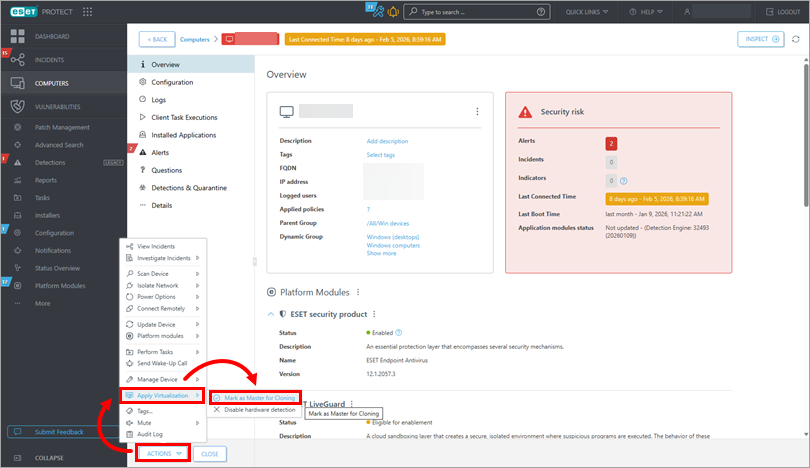
Click Actions → Apply Virtualization → Mark as Master for Cloning.
ESET PROTECT On-Prem
-
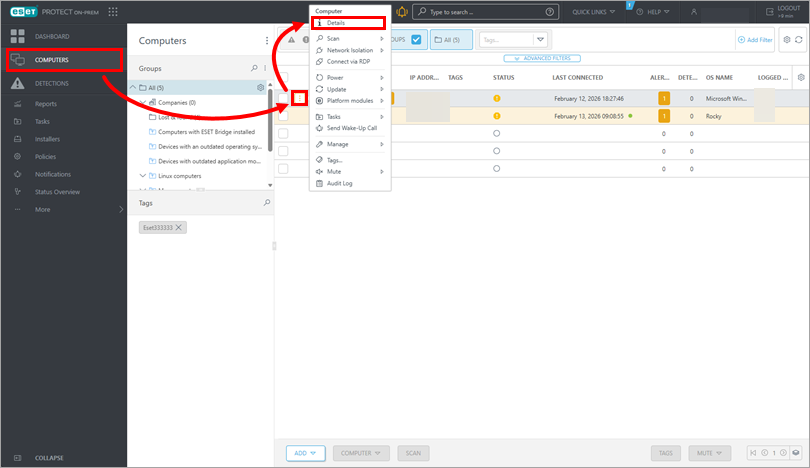
Click Computers, then click the three dots next to the target computer and select Details.
-
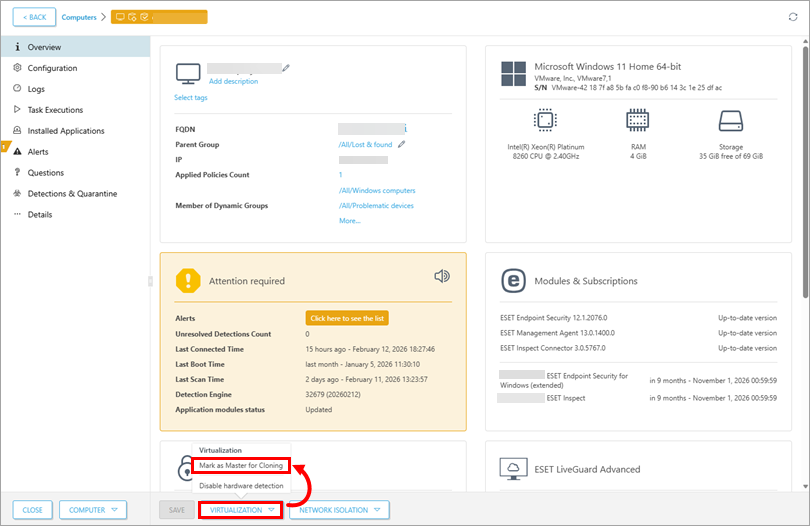
Click Virtualization → Mark as Master for Cloning.
-
-
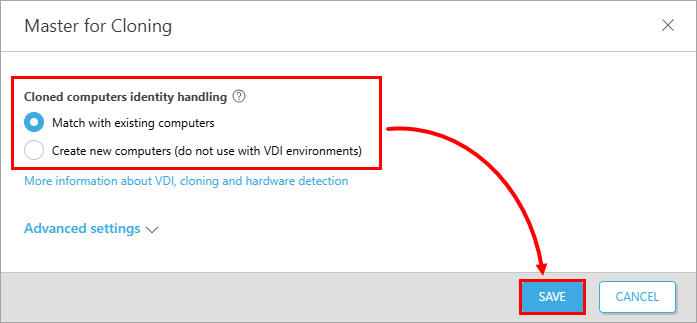
Choose how the identity of the selected computer's clones should be handled: select an option and click Save. Optionally, define the Advanced settings.
-
Match with existing computers: the computer's clones should reuse its identity and not create a duplicate (recommended for VDI and re-imaging scenarios).
-
Create new computers: the computer's clones should become a separate computer with a new identity (not recommended for VDI environments).
-
-
You can now clone the computer in your virtualization management platform and power it on. The server will recognize the clone after the first two replications; its identity will be handled according to the chosen identity-handling behavior.


